
What It Will Cost to Heat With Propane This Winter, State by State
Every October the U.S. Energy Information Administration publishes its Winter Fuels Outlook, a forecast of what households will spend to stay warm. It’s useful, but it only goes as far as four big regions. If you heat with propane in Wisconsin, a “Midwest average” doesn’t tell you much, because propane in Wisconsin costs less than half of what it does in Connecticut.
So I combined two official numbers: how much propane a typical home in each region burns over the winter, from the EIA’s outlook released Oct. 6, and the price homeowners in each state were paying in the first week of the heating season, from the EIA’s weekly survey. The result is a rough winter bill for each of the 38 states the EIA tracks.
How much propane a house actually burns
The EIA expects a typical propane-heated home to use about 494 gallons from November through March. That covers heating plus the other things propane runs in the house, like a water heater or stove. Regionally it looks like this:
- Midwest: 641 gallons. The coldest region and the biggest users. January alone is about 156 gallons.
- Northeast: 515 gallons. The EIA expects about 10% less than last winter, because it’s forecasting a milder winter there.
- South: 365 gallons. Shorter, milder winters.
The EIA doesn’t publish a propane figure for the West, so for Colorado, Idaho, Montana and Utah I used the national average of 494 gallons. Treat those four as rougher than the rest.
Estimated winter propane bill by state
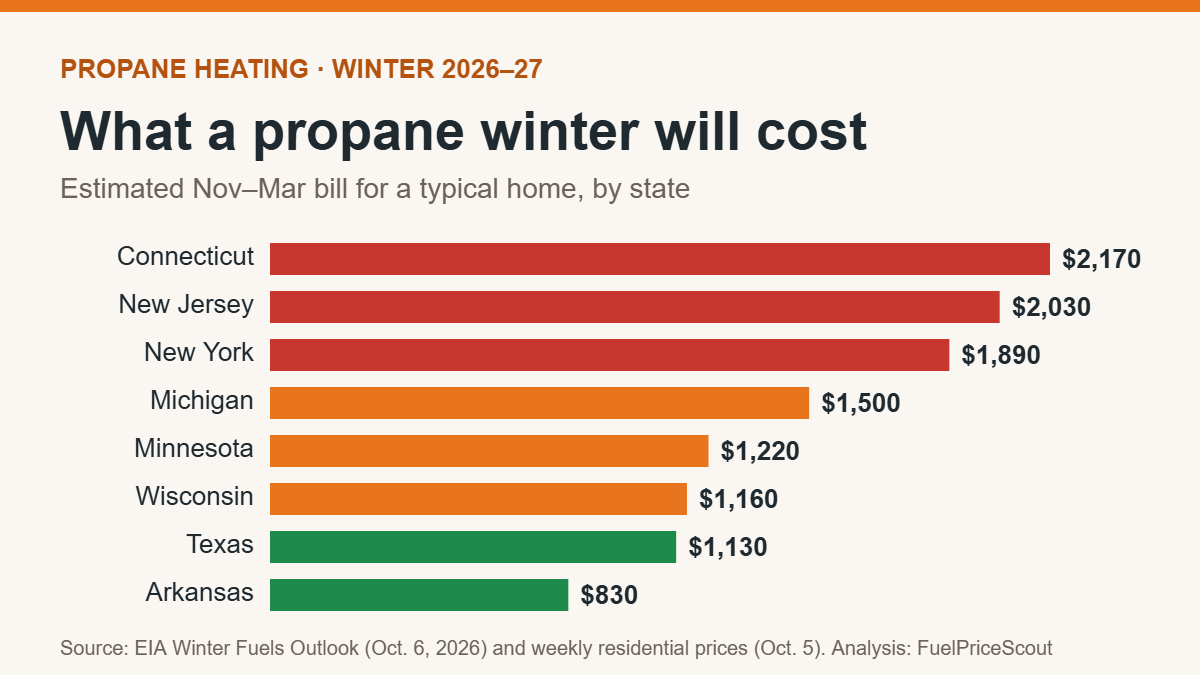
The six most and least expensive states. Estimated cost of propane from November to March for a home using its region’s typical amount, at each state’s residential price for the week of Oct. 5, 2026. Calculation by FuelPriceScout from EIA data.
The pattern is easy to read once you see it. The Midwest and Plains burn the most propane but pay the least for it, so their bills land in the middle. The Northeast burns less but pays a lot more per gallon, which puts states like Connecticut and New Jersey at the top. Florida has the highest price in the survey, $4.86 a gallon, but because Southern homes use far less, its estimated bill ($1,780) still ends up below most of the Northeast.
| State | Region | Price, Oct. 5 | Est. Nov–Mar bill | vs. last Oct. prices |
|---|---|---|---|---|
| Connecticut | Northeast | $4.21 | $2,170 | +270 |
| New Hampshire | Northeast | $3.95 | $2,040 | +210 |
| New Jersey | Northeast | $3.95 | $2,030 | +210 |
| Rhode Island | Northeast | $3.82 | $1,970 | +90 |
| Vermont | Northeast | $3.77 | $1,940 | +50 |
| New York | Northeast | $3.67 | $1,890 | +160 |
| Massachusetts | Northeast | $3.59 | $1,850 | +100 |
| Maine | Northeast | $3.55 | $1,830 | +210 |
| Florida | South | $4.86 | $1,780 | +150 |
| Ohio | Midwest | $2.57 | $1,650 | +20 |
| Pennsylvania | Northeast | $3.15 | $1,620 | +170 |
| Indiana | Midwest | $2.47 | $1,580 | +190 |
| Michigan | Midwest | $2.34 | $1,500 | +110 |
| Maryland | South | $3.80 | $1,390 | +120 |
| Virginia | South | $3.68 | $1,340 | +100 |
| Delaware | South | $3.67 | $1,340 | +120 |
| Missouri | Midwest | $2.06 | $1,320 | +70 |
| North Carolina | South | $3.58 | $1,310 | +100 |
| Kansas | Midwest | $2.01 | $1,290 | +150 |
| Alabama | South | $3.52 | $1,290 | +40 |
| Idaho* | West | $2.51 | $1,240 | +80 |
| Minnesota | Midwest | $1.90 | $1,220 | +80 |
| Colorado* | West | $2.39 | $1,180 | +160 |
| Illinois | Midwest | $1.83 | $1,170 | +70 |
| Tennessee | South | $3.19 | $1,170 | +80 |
| Wisconsin | Midwest | $1.81 | $1,160 | +70 |
| Texas | South | $3.10 | $1,130 | +60 |
| Georgia | South | $3.08 | $1,120 | +30 |
| Mississippi | South | $3.05 | $1,110 | +40 |
| South Dakota | Midwest | $1.73 | $1,110 | +60 |
| Utah* | West | $2.23 | $1,100 | -10 |
| Nebraska | Midwest | $1.70 | $1,090 | +80 |
| Iowa | Midwest | $1.63 | $1,050 | +70 |
| North Dakota | Midwest | $1.61 | $1,030 | +110 |
| Kentucky | South | $2.67 | $980 | +80 |
| Montana* | West | $1.91 | $950 | +40 |
| Oklahoma | South | $2.29 | $840 | +40 |
| Arkansas | South | $2.29 | $830 | +40 |
*Western states use the U.S. average consumption because the EIA doesn’t publish a West propane estimate. “vs. last Oct. prices” is the same amount of propane priced at the first week of last season. Your bill depends on your house, thermostat, insulation and dealer.
Three things the numbers say
1. The price you lock in matters more than the weather forecast
In Minnesota, the difference between this October’s price and last October’s is about 12 cents a gallon. Over 641 gallons that’s roughly $80 for the winter. In Connecticut, prices are up 52 cents, which adds about $270 on 515 gallons. A good prebuy or fixed-price contract can be worth more than a mild winter.
2. The EIA expects prices to ease, but the season started higher
The outlook forecasts an average of $2.52 a gallon nationally this winter, about 2% below last winter. Yet the first weekly reading of the season came in at $2.60, 18 cents higher than the same week last year. Both can be true: the forecast covers the whole winter, and prices often move after October. It’s a reason to watch your dealer’s price over the next few weeks rather than assume it will fall.
3. January is the month that hurts
In the Midwest the EIA expects about 156 gallons in January alone, close to a quarter of the winter. If your tank is 500 gallons, you’ll likely need at least one delivery in the middle of winter, when prices and demand are highest. Getting the tank filled in fall and asking for automatic delivery helps you avoid running low in a cold snap.
What I’d do now
- Get your own number. The propane heating cost calculator lets you plug in your home’s size, climate, insulation and your state’s price instead of a regional average.
- Call your dealer before November. Ask for the current price, any prebuy or price-cap plan, and the fee for small deliveries. Compare with the price for your state in the table above or on propane prices by state.
- Check your tank. If you lease it, switching dealers can be harder. The guide on leased vs. owned propane tanks explains your options.
- If the bill is going to be a stretch, apply early. Many state heating assistance programs open in the fall and money can run out. Here’s how to get help paying for propane.
How I worked this out
Estimated bill = the EIA’s forecast of propane use per household for the state’s Census region (November through March, all propane uses in a propane-heated home) × that state’s average residential propane price for the week of Oct. 5, 2026. It’s a rough guide, not a prediction for your home: the EIA’s own figures are averages, prices will move during the winter, and a small, well-insulated house can use half as much as a large, drafty one. Expenditures in the EIA outlook are in nominal dollars.
Sources: U.S. Energy Information Administration, Winter Fuels Outlook 2026–27 (released Oct. 6, 2026); EIA Heating Oil and Propane Update (residential propane prices, week of Oct. 5, 2026, and the same week of 2025).